Are Ottawa Knee Rules Really Useful?
International Journal of Disaster Medicine, 4, 41-49 · 2006 · doi:10.1080/15031430600865893
Plain-language summary
An earlier, smaller companion study (100 patients) to the group's later 2007 paper on this site, again testing whether applying the Ottawa Knee Rules via a sticker prompt changed X-ray ordering after acute knee injury. Results were consistent with the later, larger study: 42% of patients managed without the rule were X-rayed versus 48% managed with it — no significant reduction.
Why this matters
Replicating a null result across two separate patient cohorts strengthens the conclusion that simply introducing a decision rule, without more active implementation support, is unlikely to change clinician ordering behaviour on its own.
Published abstract
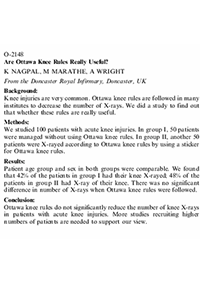
Background: Knee injuries are very common. Ottawa Knee Rules are followed in many institutes to decrease the number of X-rays. We did a study to find out whether these rules are really useful. Methods: We studied 100 patients with acute knee injuries. In group I, 50 patients were managed without using Ottawa Knee Rules. In group II, another 50 patients were X-rayed according to Ottawa Knee Rules by using a sticker for Ottawa Knee Rules. Results: Patient age group and sex in both groups were comparable. 42% of the patients in group I had their knee X-rayed; 48% of the patients in group II had X-ray of their knee. There was no significant difference in number of X-rays when Ottawa Knee Rules were followed. Conclusion: Ottawa Knee Rules do not significantly reduce the number of knee X-rays in patients with acute knee injuries. More studies recruiting higher numbers of patients are needed to support our view.
Read the full publication
Keywords
Ottawa Knee Rules knee injury radiography clinical decision tool
Cite this publication
Nagpal K, Marathe M, Wright A. Are Ottawa Knee Rules Really Useful?. International Journal of Disaster Medicine. 2006;4:41-49. doi:10.1080/15031430600865893Copied!